Booking choice: The private West Bank day tour, from $89 per person. Check dates Tour details
Deir el-Bahari has been dug since the 19th century, and it keeps surprising people. The biggest recent news came in January 2025, when Zahi Hawass presented three years of work just below Hatshepsut's temple. A month later a British-Egyptian team named the tomb of her husband, Thutmose II.
This post covers those finds, the restorers on the terraces, and what changed at the site in 2026. Every claim links to the announcement or report behind it.
The quick answer
In January 2025 a joint mission of the Zahi Hawass Foundation and the Ministry of Tourism and Antiquities announced the foundations of Hatshepsut's valley temple, more than 1,500 painted blocks, the temple's foundation deposit and a Senenmut tablet, plus tombs from the Middle Kingdom to the Ptolemaic era. In February 2025 Thutmose II's tomb was identified west of the Valley of the Kings. In 2026 the Ministry is upgrading the temple's visitor centre.
What did Zahi Hawass's mission find at Hatshepsut's temple?
The lost valley temple at the bottom of the causeway: an intact stretch of its foundations and more than 1,500 decorated blocks, many still coloured. The announcement was made in Luxor in January 2025.
Every pharaoh's mortuary temple had a small partner by the river, the valley temple, linked by a causeway. Hatshepsut's had been mostly lost. The joint mission of the Zahi Hawass Foundation and the Ministry worked for three years along the causeway and found the foundations and the blocks that once lined the walls.
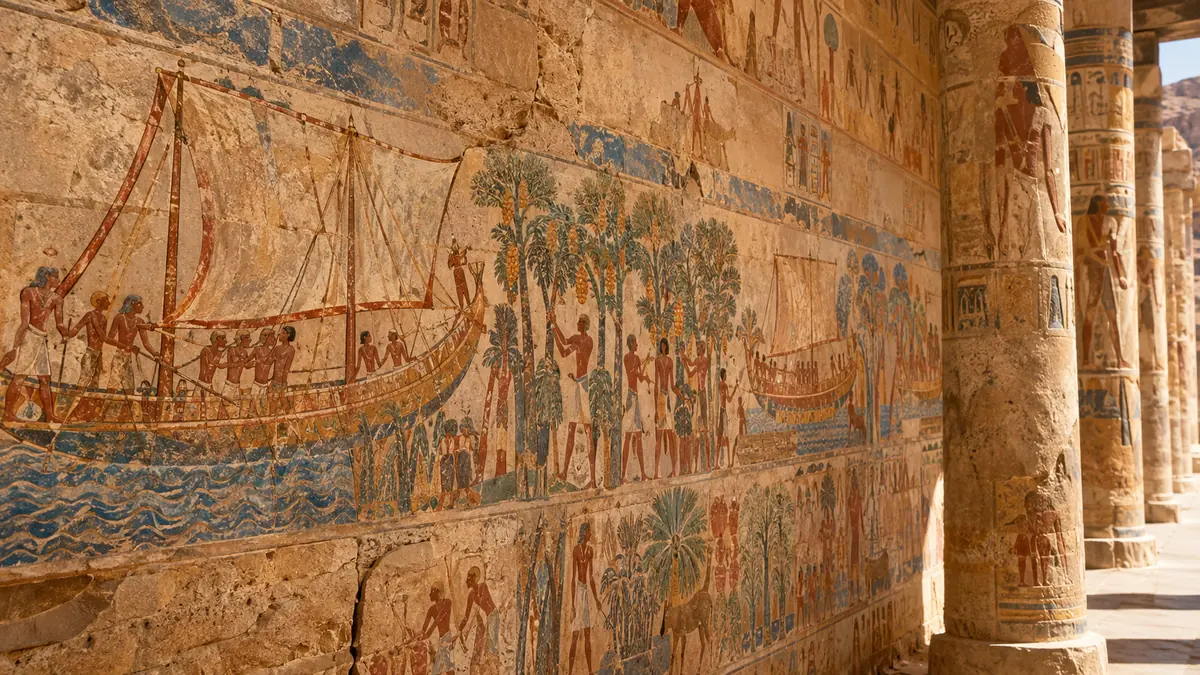
The reliefs show Hatshepsut and Thutmose III performing rituals. Hawass called them "the most beautiful scenes I've ever seen in my life with the color", according to Archaeology magazine, and wrote on his own site that "we now have the complete program of the valley temple" with "evidence that Thutmose III restored this temple."
That last part is the twist. Thutmose III is the king who later had Hatshepsut's statues smashed and her name cut out. Here he seems to have repaired her building.
| Find (announced January 2025) | Where | Why it matters |
|---|---|---|
| Intact foundations of the valley temple | Bottom of the causeway | Locates a lost part of the complex |
| More than 1,500 decorated blocks | Around the valley temple | Gives its full scheme of scenes |
| Foundation deposit with builders' tools | Under the temple | Dates and names the building |
| Limestone tablet naming Senenmut | Valley temple area | Links it to her chief architect |
| Signs of repair by Thutmose III | Valley temple | Complicates the 'erasure' story |
What was in Hatshepsut's foundation deposit?
Builders' tools and models buried at the start of construction: an adze, a wooden hammer, two chisels, a mould for mud bricks and two stones with Hatshepsut's cartouches.
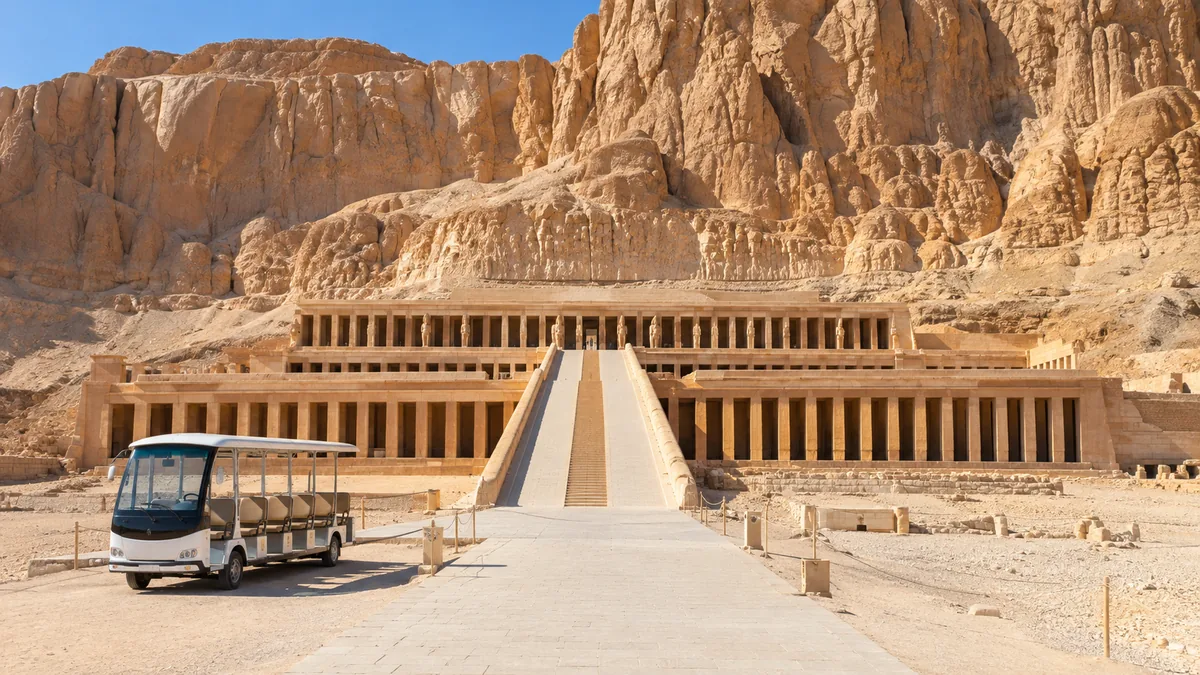
Egyptian builders buried a small kit of tools and offerings under a temple's corners when they laid it out. The list from this one, reported by Live Science, reads like a site shed: an adze, a wooden hammer, two chisels, a wooden mould for mud bricks and two stones bearing her cartouches. Several pieces carry the line "the good god Neb Maat Re, in the temple Djeser Djeseru, beloved by Amun". Djeser Djeseru, "holiest of holies", is the temple you walk up today.
A limestone tablet with the name of Senenmut, the steward and architect closely tied to the queen, came from the same area. It is the kind of small object that matters more than it looks: a direct link between the man and this building.
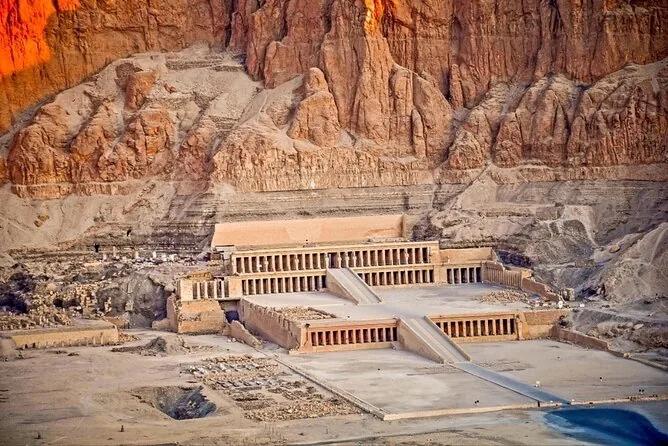
Which tombs were found around the temple?
A 17th Dynasty cemetery with rishi coffins and archery gear, the tomb of Djehutymes, overseer of Queen Tetisheri's palace, Middle Kingdom rock-cut tombs and part of a Ptolemaic cemetery.
The same mission cleared the slopes beside the causeway. The oldest burials are Middle Kingdom rock-cut tombs. Then come 17th Dynasty shafts with intact wooden rishi coffins, the feathered style of the period, including one for a child, according to Current World Archaeology. One coffin was found tied with ropes, with bows and arrows that Hawass links to the war against the Hyksos.
The tomb of Djehutymes, overseer of the palace of Queen Tetisheri (grandmother of Ahmose, the king who drove the Hyksos out), held a limestone offering table, a funerary stela and a cosmetics vessel of alabaster and faience. On top of all this, the team found part of a much later Ptolemaic necropolis.
The same team kept working in 2026. In March it announced 22 painted coffins of "Singers of Amun" and eight sealed papyri in a rock-cut chamber by the tomb of Seneb in the Qurna area of the West Bank, Egypt Independent reported.
| Period | Find | Date announced |
|---|---|---|
| Middle Kingdom | Rock-cut tombs by the causeway | January 2025 |
| 17th Dynasty | Rishi coffins, a child's coffin, bows and arrows | January 2025 |
| Early 18th Dynasty | Tomb of Djehutymes, overseer of Tetisheri's palace | January 2025 |
| Ptolemaic | Part of a later necropolis | January 2025 |
| Third Intermediate Period | 22 coffins and 8 papyri at the tomb of Seneb, Qurna | March 2026 |
Where is the tomb of Thutmose II, Hatshepsut's husband?
In Wadi C, about 2.4 km west of the Valley of the Kings. A British-Egyptian mission identified it as tomb C4 in February 2025. It is not open to visitors.
The entrance was spotted in October 2022 below the cliff tomb of Neferure, Hatshepsut's daughter. After clearing flood debris the team found alabaster fragments inscribed with Thutmose II's name and with Hatshepsut's, which suggests she buried him, as summarised on Wikipedia. The mission is led by Piers Litherland of the New Kingdom Research Foundation with the Ministry. It was the first tomb of a New Kingdom king identified since Tutankhamun's.
The tomb is empty and badly flooded. Litherland thinks the burial was moved soon after, and he is looking for that second tomb. Thutmose II's mummy has been known for over a century: it came from the royal cache found at Deir el-Bahari itself.
What is changing at Hatshepsut's temple for visitors in 2026?
A rebuilt visitor centre with an interactive hall about the temple and 11 electronic ticket gates, announced in April 2026 for completion before the winter season. The Polish restorers are still at work on the terraces.
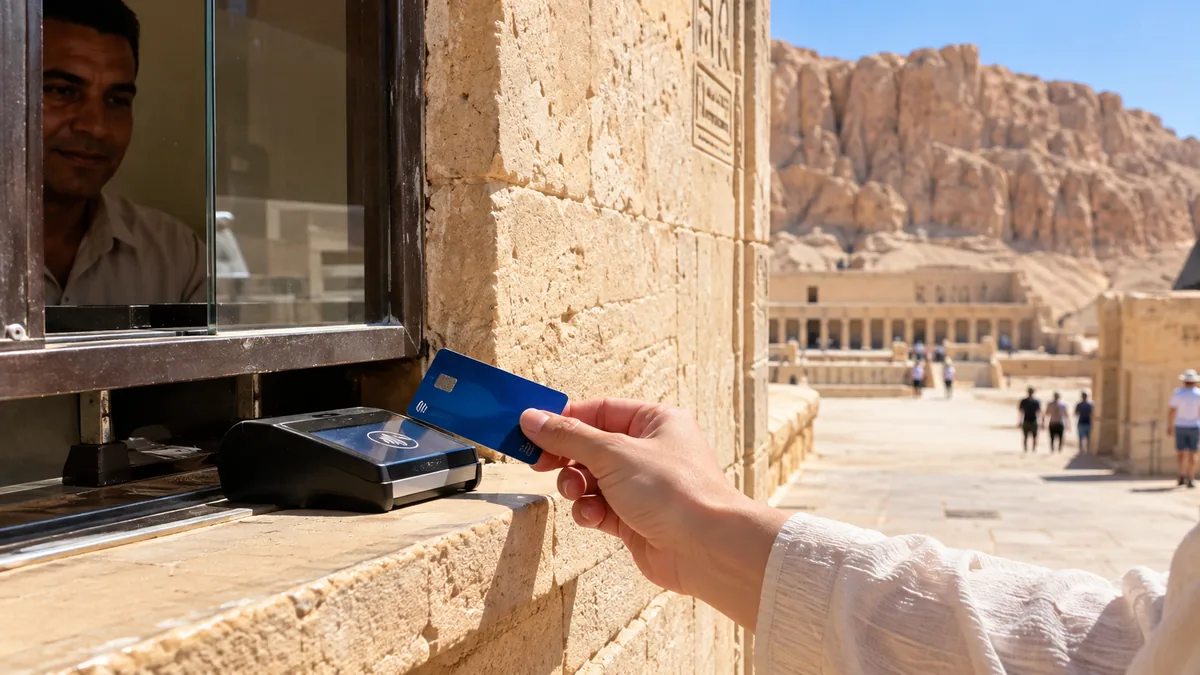
In April 2026 the Ministry announced restoration and development works at Karnak, Luxor Temple and Hatshepsut's temple, to be done "before the start of the winter tourist season" (State Information Service). At Deir el-Bahari that means a visitor centre with an interactive hall and 11 electronic gates (Egypt Independent). Expect faster ticket checks this winter.
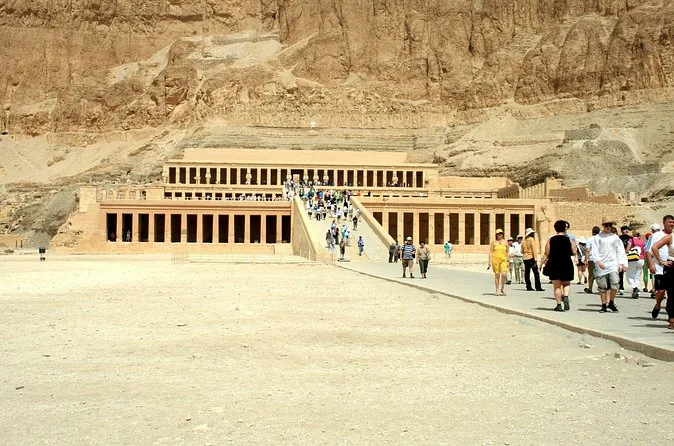
Up on the terraces, the Polish-Egyptian mission of the University of Warsaw has worked since 1961. It has rebuilt more than 20 sphinxes and Osiride statues from fragments, Research in Poland reported in 2025. The colossal Osiride figures you photograph on the top terrace are their work, and so are the two Rooms of Amun opened beside the sanctuary in 2023. The history behind all this is in our Hatshepsut temple history guide.
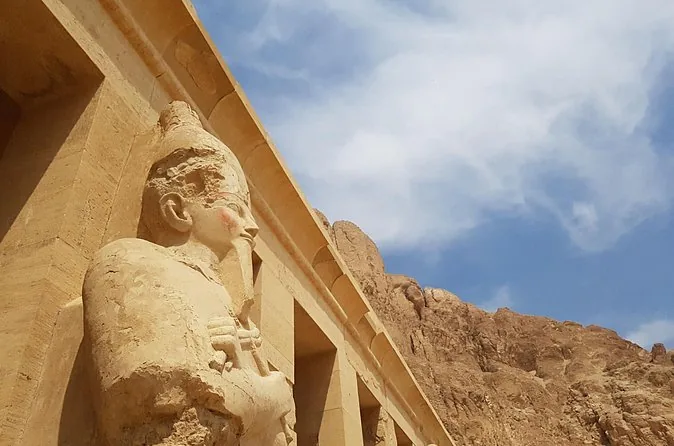
A private West Bank day with the tickets included: the Valley of the Kings, Hatshepsut, Medinet Habu and more.
Check dates for the private West Bank day tourFrequently asked questions
What was discovered at Hatshepsut's temple in 2025?
The foundations of her valley temple, more than 1,500 painted blocks, the foundation deposit with builders' tools, a tablet naming Senenmut and several tombs nearby. It was announced in January 2025.
Can visitors see the new finds at Deir el-Bahari?
No display of the finds has been announced. The temple itself is open as usual, daily from 06:00 to 17:00.
Who restored the Hatshepsut temple?
Mainly the Polish-Egyptian mission of the University of Warsaw, working since 1961. It rebuilt the upper terrace, its rooms and more than 20 statues.
Was Thutmose II's tomb found near Hatshepsut's temple?
In the hills behind it. Tomb C4 lies in Wadi C, about 2.4 km west of the Valley of the Kings, and was identified in February 2025. It is not open to the public.
Ready to book
Choose your tour
Free cancellation up to 24 hours before on every option. Prices are from-prices in USD and move with the season.
Valley of the Kings, Queens & Hatshepsut Day Tour
- Private Egyptologist guide and air-conditioned car
- Pickup anywhere in Luxor (airport $10 extra)
- Entry to the Valley of the Kings (3 tombs), Hatshepsut, Habu, Deir el-Medina and the Valley of the Queens
Full-Day Luxor West Bank Temples & Tombs
Six West Bank sites at your pace; guide and tickets by option