Booking choice: The private West Bank day tour, from $89 per person. Check dates Tour details
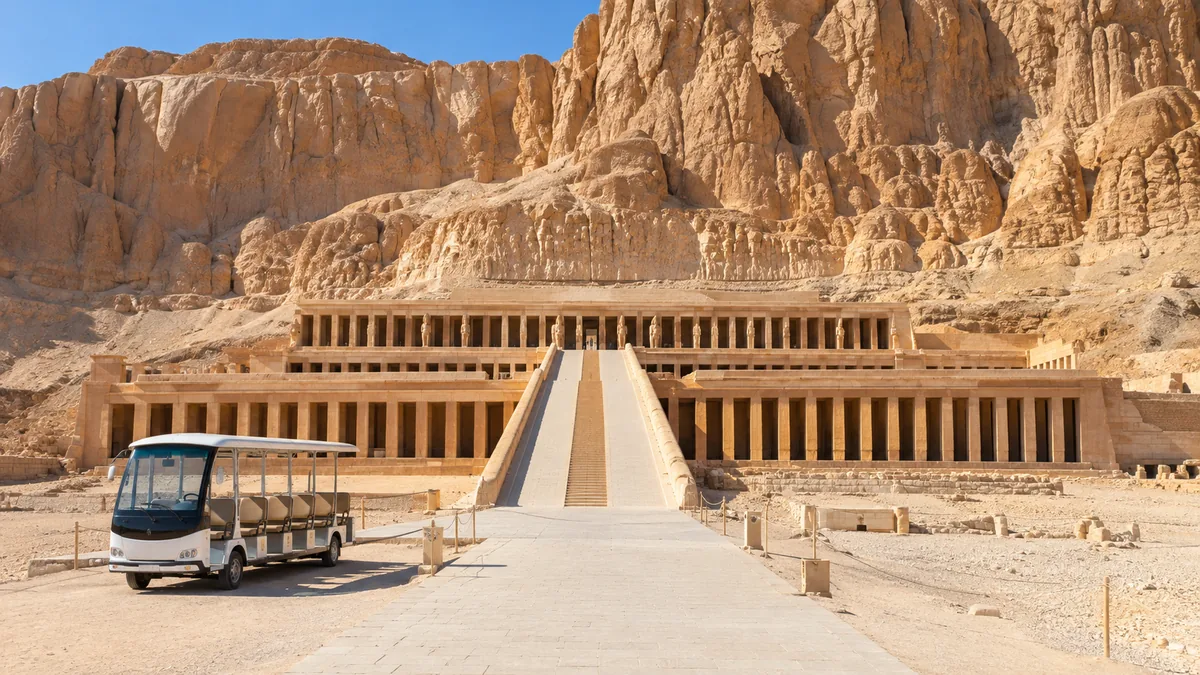
The temple at Deir el-Bahari was built for Hatshepsut, who ruled Egypt as king around 1473 to 1458 BC, and for the cult of her father Thutmose I (Ministry of Tourism and Antiquities). Its ancient name was Djeser-Djeseru, the Holy of Holies.
Most tours give you an hour here. That is enough if you know where to look. This guide tells the story in eight questions and ends with a route through the three terraces.
The quick answer
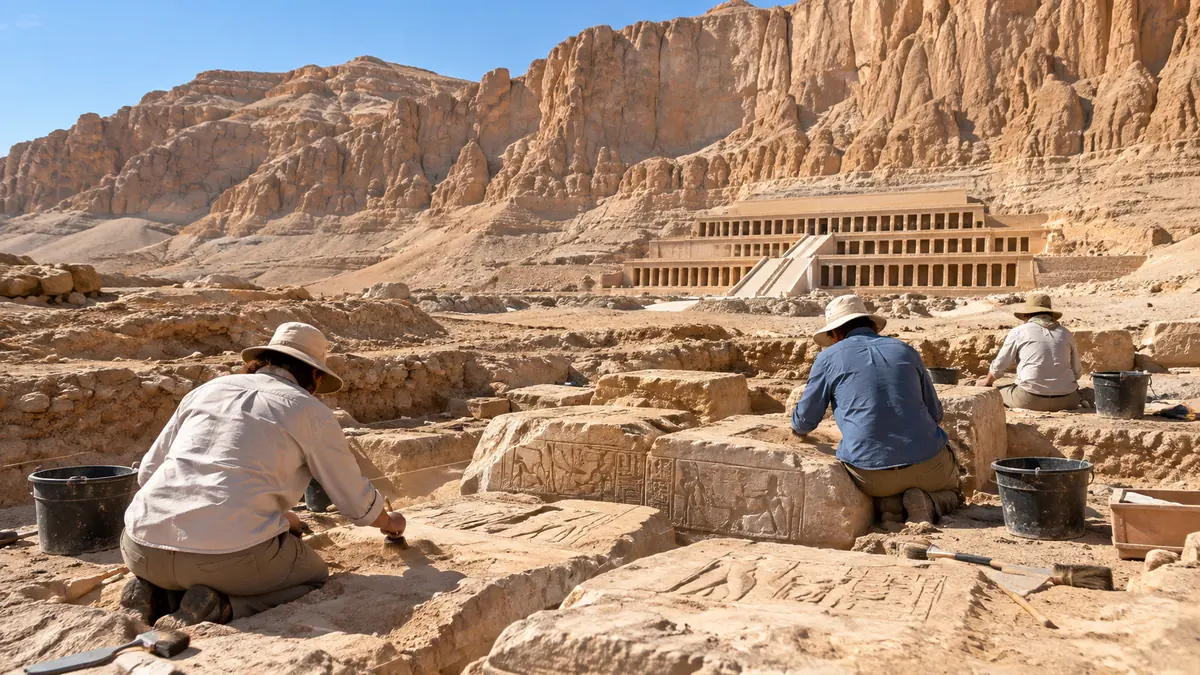
Hatshepsut was the daughter of Thutmose I who ruled first as regent for the young Thutmose III, then as king. Her steward Senenmut is credited with the design. On the middle terrace, the left colonnade shows the expedition to Punt and the right one her divine birth from Amun, with chapels to Hathor and Anubis at either end. Her images were hacked out about 20 years after her death. Since 1961 a Polish-Egyptian mission has rebuilt much of what you see.
Who was Hatshepsut?
A queen of the 18th Dynasty who made herself king. She ruled around 1473 to 1458 BC, one of the few women to hold the throne of Egypt in her own right.
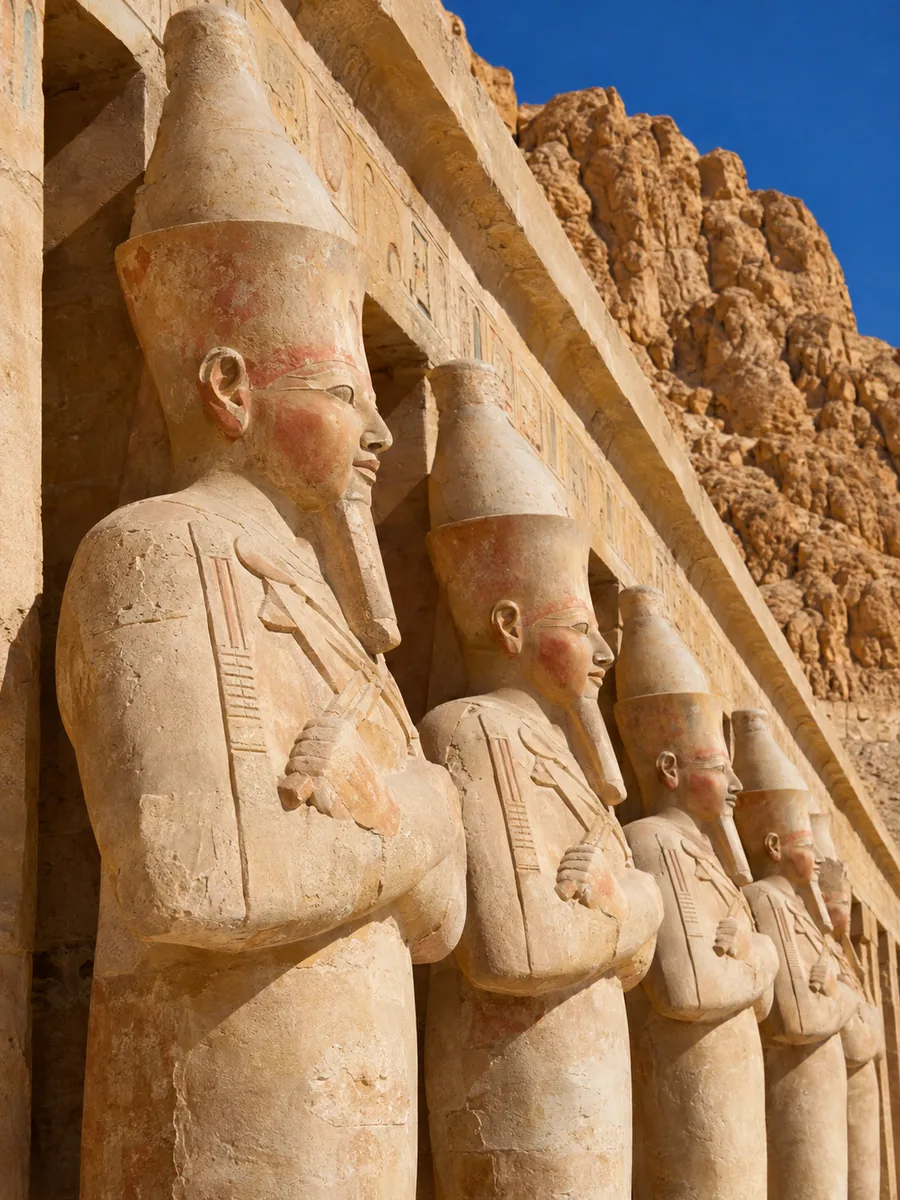
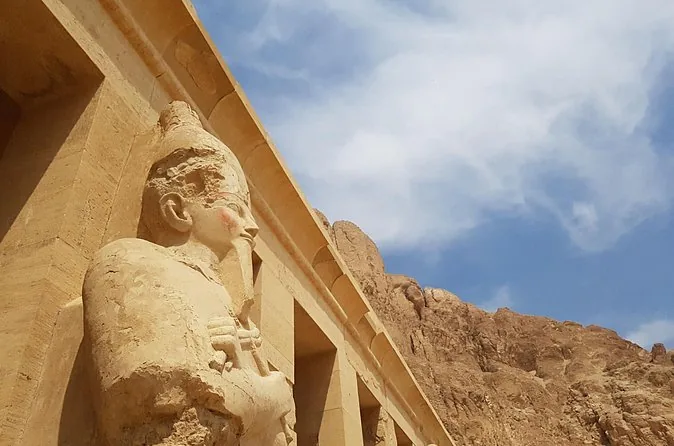
She was the daughter of Thutmose I and the wife of her half-brother Thutmose II. When he died, the heir was Thutmose III, a small boy born to a lesser wife. Hatshepsut ruled for him as regent, then took the full titles of a pharaoh. Her statues show her with a king's headdress and false beard. Her reign was peaceful and rich: trade, building, and the obelisks at Karnak.
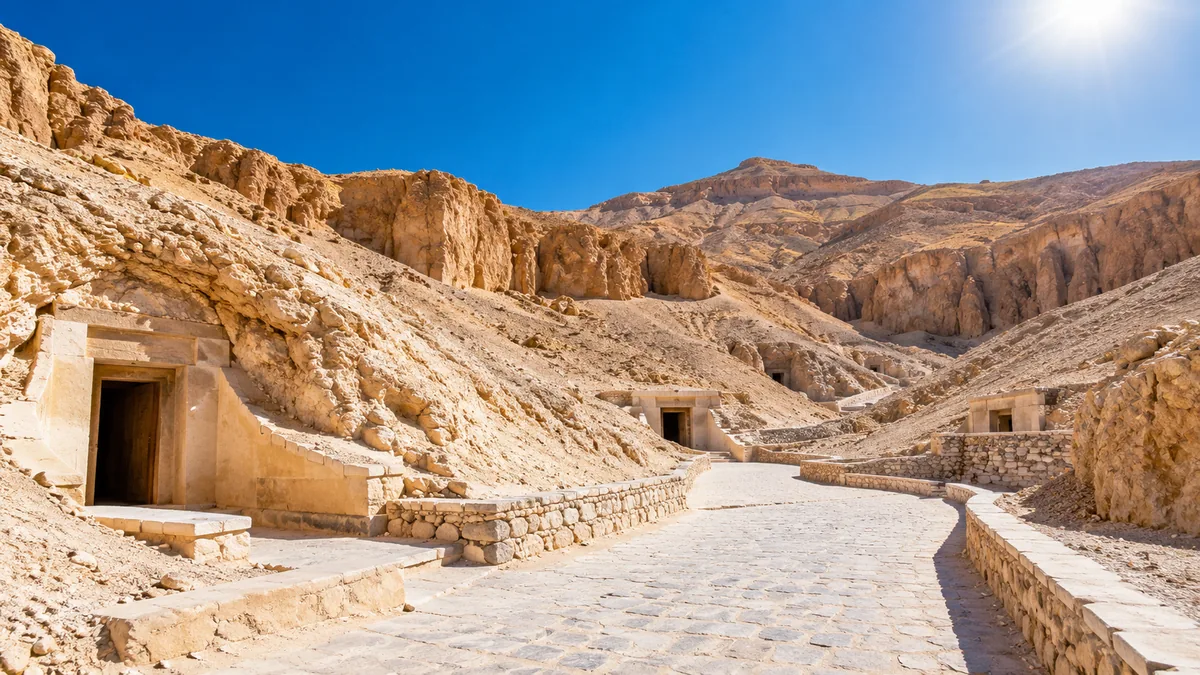
Her mummy was identified in 2007 and is now in the National Museum of Egyptian Civilization in Cairo. Her tomb in the Valley of the Kings (KV20) is not open to visitors.
Who built the Temple of Hatshepsut?
Senenmut, the queen's steward of Amun, is named as its designer. It was built between about year 7 and year 20 of her reign.
The Ministry's monument page names "the chief steward of Amun, Senenmut". He was also tutor to Hatshepsut's daughter Neferure, and his rise from a modest family is one of the period's great careers. He cut a second tomb for himself (TT353) under the temple's forecourt, and carved small figures of himself in the temple where the open shrine doors would hide them. A guide can show you one.
The temple took over a decade and changed design several times (Wikipedia). It borrows the idea of terraces from the older temple of Mentuhotep II right next door, built about 600 years earlier and now a ruin.
What does Djeser-Djeseru mean?
The Holy of Holies. The cliff bay was sacred to Hathor long before Hatshepsut built here.
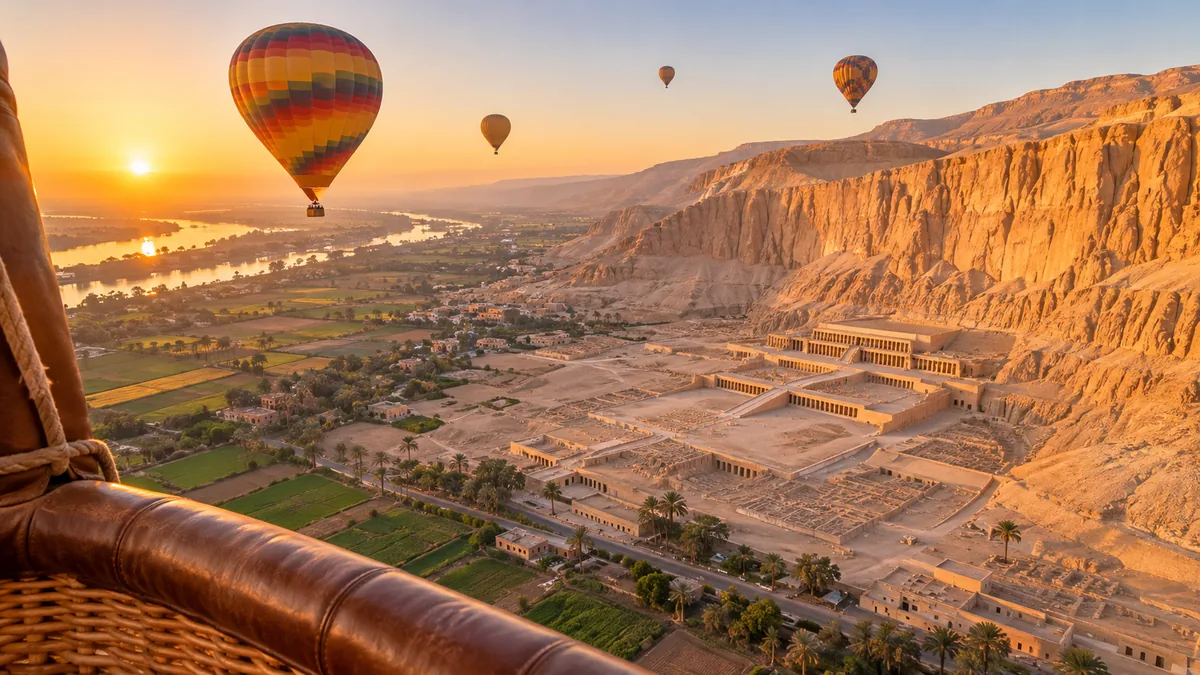
The Ministry describes Deir el-Bahari as a place "sacred to Hathor, the goddess who nursed and reared every king", believed to show herself in the hills. The temple's main axis points east across the Nile toward Karnak. Each year, in the Beautiful Festival of the Valley, Amun's sacred boat crossed the river and came to rest in the sanctuary cut into the rock.
The axis is also aligned with the winter solstice sunrise: around 21 December the sun reaches the back of the inner sanctuary (Egypt Independent). The name Deir el-Bahari is much later: Arabic for "monastery of the north", after a Coptic monastery built on the upper terrace.
What are the three terraces of Hatshepsut's temple?
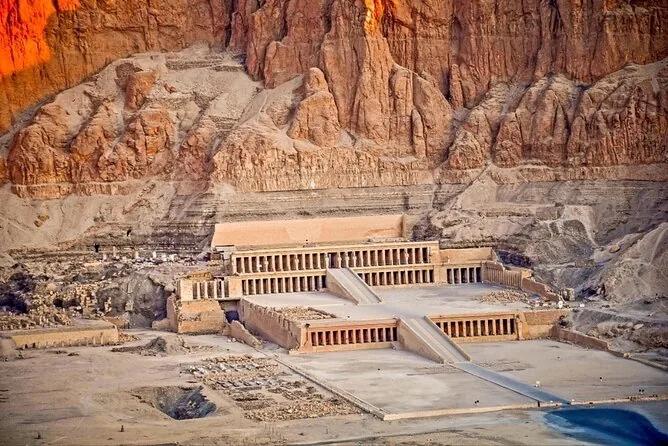
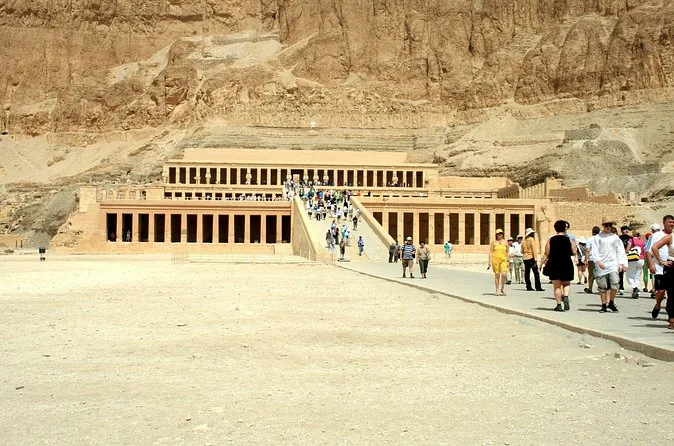
Three stacked courts joined by ramps, each fronted by a colonnade. The lower is the approach, the middle holds the story reliefs and two chapels, the upper holds the sanctuary.
- Lower terrace: a wide court, once a garden with trees and pools, behind a double colonnade with scenes of obelisks being shipped to Karnak.
- Middle terrace: the Punt colonnade on the left, the birth colonnade on the right, the Hathor chapel at the far left and the Anubis chapel at the far right.
- Upper terrace: the Osiride statues of the queen along the front, a festival court, the sanctuary of Amun in the cliff, the solar cult court with its open-air altar to Ra-Horakhty, and the royal cult chapels.
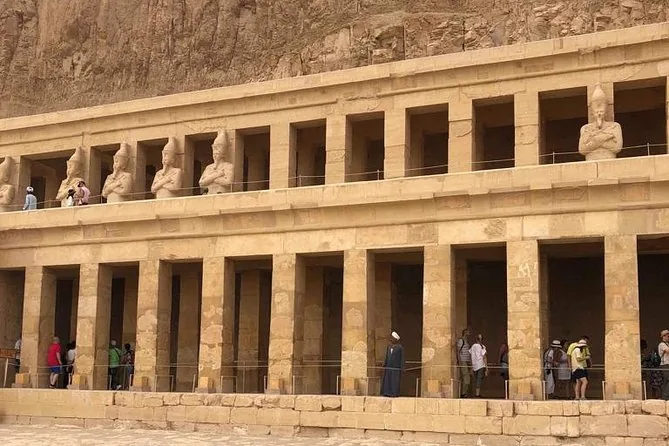
See it with an Egyptologist who knows where Senenmut hides: the private West Bank day.
Check dates for the private West Bank day tourWhat do the Punt reliefs show?
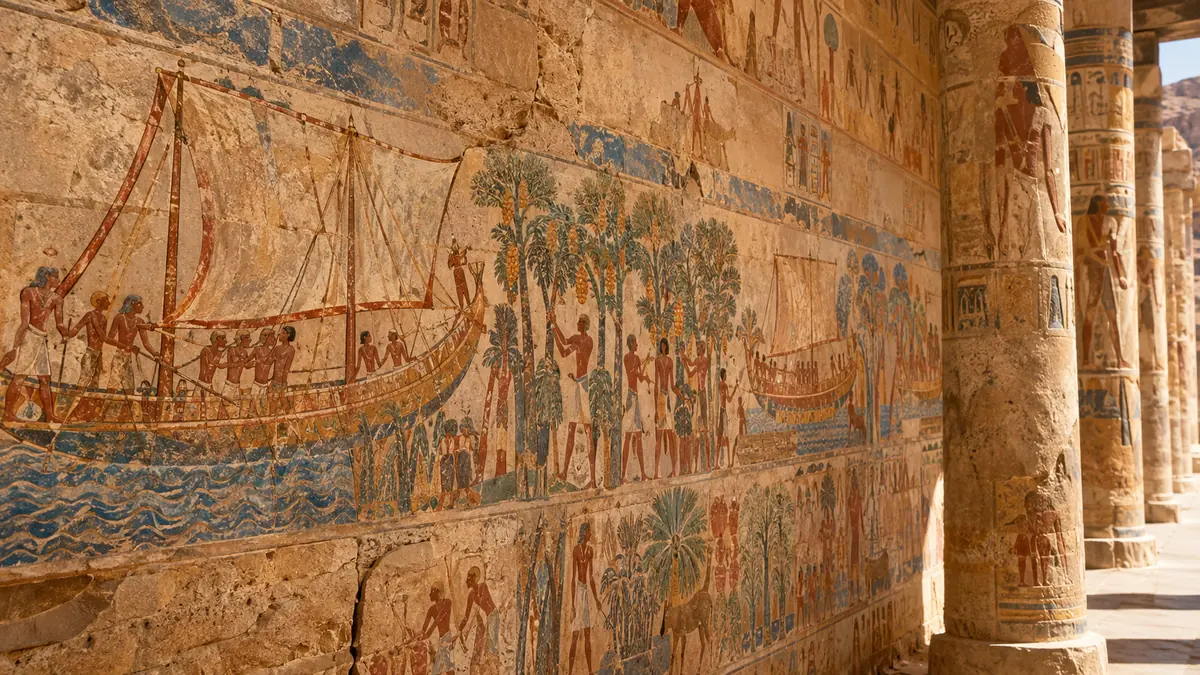
Hatshepsut's trade expedition to Punt, a land on the Red Sea coast of Africa, and the incense trees, animals and gold the ships brought home.
Punt is believed to have been near modern Eritrea (Ministry). The left side of the middle colonnade shows the ships setting out, the houses on stilts in Punt, its king and his famously stout queen, and the loading of myrrh trees in baskets, roots and all. The trees were replanted in front of the temple. The block with the queen of Punt is now in the Egyptian Museum in Cairo; the one on the wall is a cast.
Look for the fish under the boats. The sculptors carved them species by species, and they are still identifiable today.
What is the divine birth colonnade?
The right side of the middle terrace, where Hatshepsut tells how the god Amun fathered her: her claim to the throne, carved in stone.
The Ministry puts it plainly: here Hatshepsut "relates how she is the rightful king of Egypt", because "her true father was none other than the god Amun himself". The scenes show Amun visiting her mother Ahmose, the ram-headed god Khnum shaping the child and her ka on a potter's wheel, and the birth itself. Many figures of the queen here were chiselled away later. The gaps tell that part of the story.
What are the Hathor and Anubis chapels?
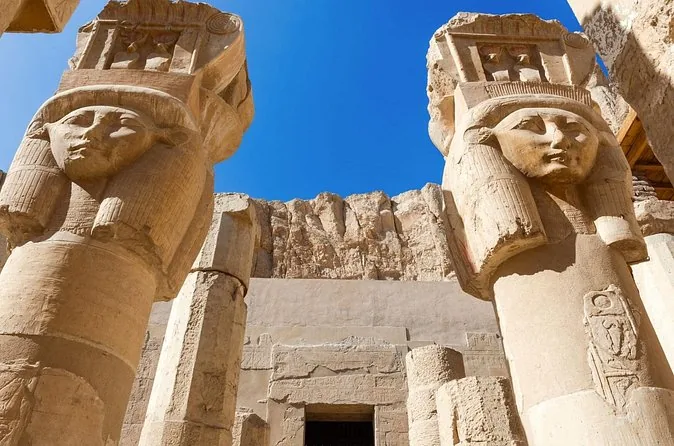
Two shrines at either end of the middle terrace: Hathor's on the left with cow-eared columns, Anubis's on the right with the best-preserved colour in the temple.
The Hathor chapel has columns topped with the goddess's face and cow ears. Inside, reliefs show Hathor as a cow licking the queen's hand, and Hatshepsut drinking from her udder: divine milk for a divine king. The Anubis chapel, at the north end, still has bright blues and reds on its ceiling and walls. If you only step into one room, make it this one.
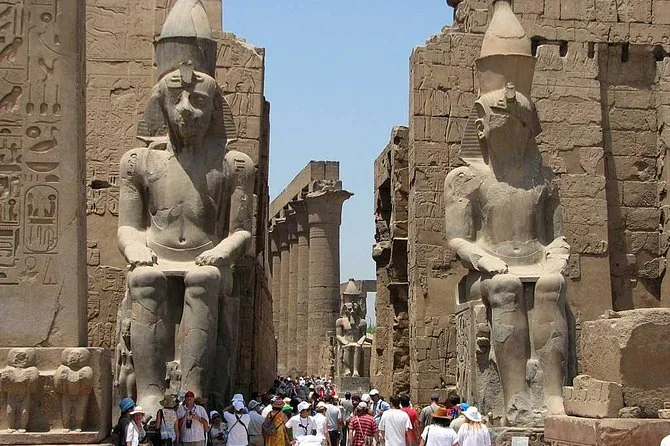
Hatshepsut's temple in the morning, Karnak in the afternoon: see her obelisk there too. Lunch and tickets included.
Explore the East and West Bank day tour Tour detailsWhy did Thutmose III erase Hatshepsut?
Nobody knows for sure. The erasure came about 20 years after her death, late in his reign, which argues against simple revenge.
Her names and images were cut out, her statues broken and dumped in a quarry nearby. The Metropolitan Museum excavated thousands of fragments there in the 1920s and pieced many back together; several of the statues are in New York today (The Met). The excavator, Herbert Winlock, blamed spite. Recent scholars see a political move to make the line from Thutmose I to Thutmose III look unbroken, and read the statue breaking as ritual deactivation more than rage.
Your guide will show you a hacked-out figure. Once you spot one, you see them everywhere.
Who restored the Temple of Hatshepsut?
The Polish-Egyptian Archaeological and Conservation Mission, working with Egypt's antiquities ministry since 1961.
The mission was founded by Kazimierz Michałowski of the University of Warsaw and is now run by its Polish Centre of Mediterranean Archaeology, directed by Patryk Chudzik (the mission's site). Its teams rebuilt the upper terrace, many of the Osiride statues and the solar cult complex, which reopened in 2015. A guest from Hurghada noticed: the temple "has been wonderfully restored by the Polish archaeological team who have been onsite for many years". Expect some new stone among the old, and the odd scaffold.
Frequently asked questions
Why is the Temple of Hatshepsut famous?
Its terraced design against the cliff has no real parallel in Egypt, and its walls record the Punt expedition and a woman's claim to be king.
How long did Hatshepsut rule?
About 15 years as king, around 1473 to 1458 BC, after a period as regent for Thutmose III.
Is Hatshepsut buried in her temple?
No. The temple was for her cult. Her tomb is KV20 in the Valley of the Kings, and her mummy is in Cairo's National Museum of Egyptian Civilization.
What should I see first at Hatshepsut's temple?
Go up the ramp to the middle terrace, turn left for the Punt reliefs and the Hathor chapel, cross to the Anubis chapel, then climb to the upper terrace.
Ready to book
Choose your tour
Free cancellation up to 24 hours before on every option. Prices are from-prices in USD and move with the season.
Valley of the Kings, Queens & Hatshepsut Day Tour
- Private Egyptologist guide and air-conditioned car
- Pickup anywhere in Luxor (airport $10 extra)
- Entry to the Valley of the Kings (3 tombs), Hatshepsut, Habu, Deir el-Medina and the Valley of the Queens
Hatshepsut, Valley of the Kings, Karnak & Luxor Temple
Both banks in one day, with lunch and tickets included